← All projects

CASE STUDY · PRODUCT · INTERNAL OPERATIONS

eUp Onboarding Hub

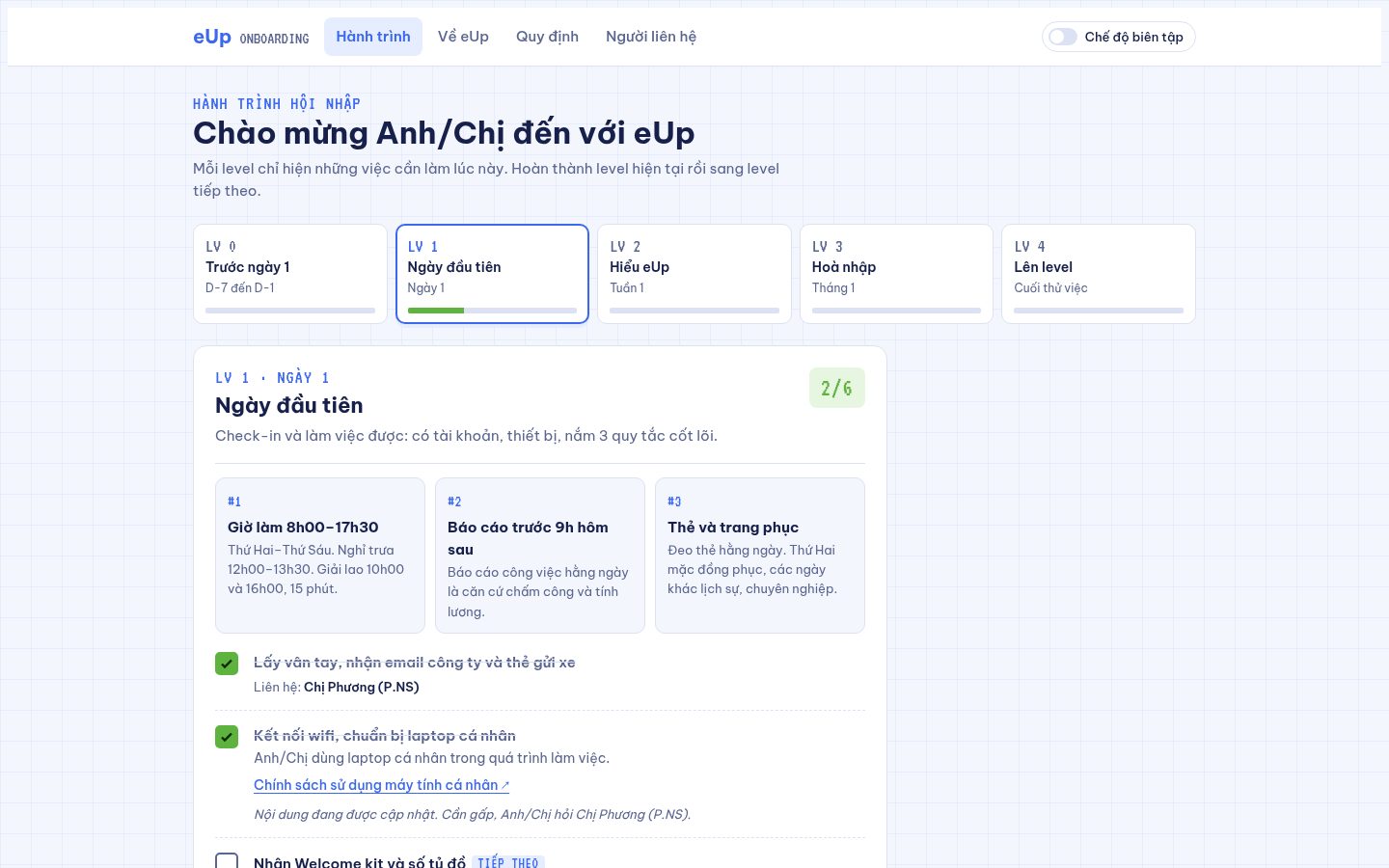
Onboarding website for new hires: a 5-level journey over time, summarised policies, a contact directory and an editing mode for HR.

ROLE
Research, UX/UI & development
STATUS
Beta
YEAR
2026
FIELD
Onboarding · HR · Web app
01

Context

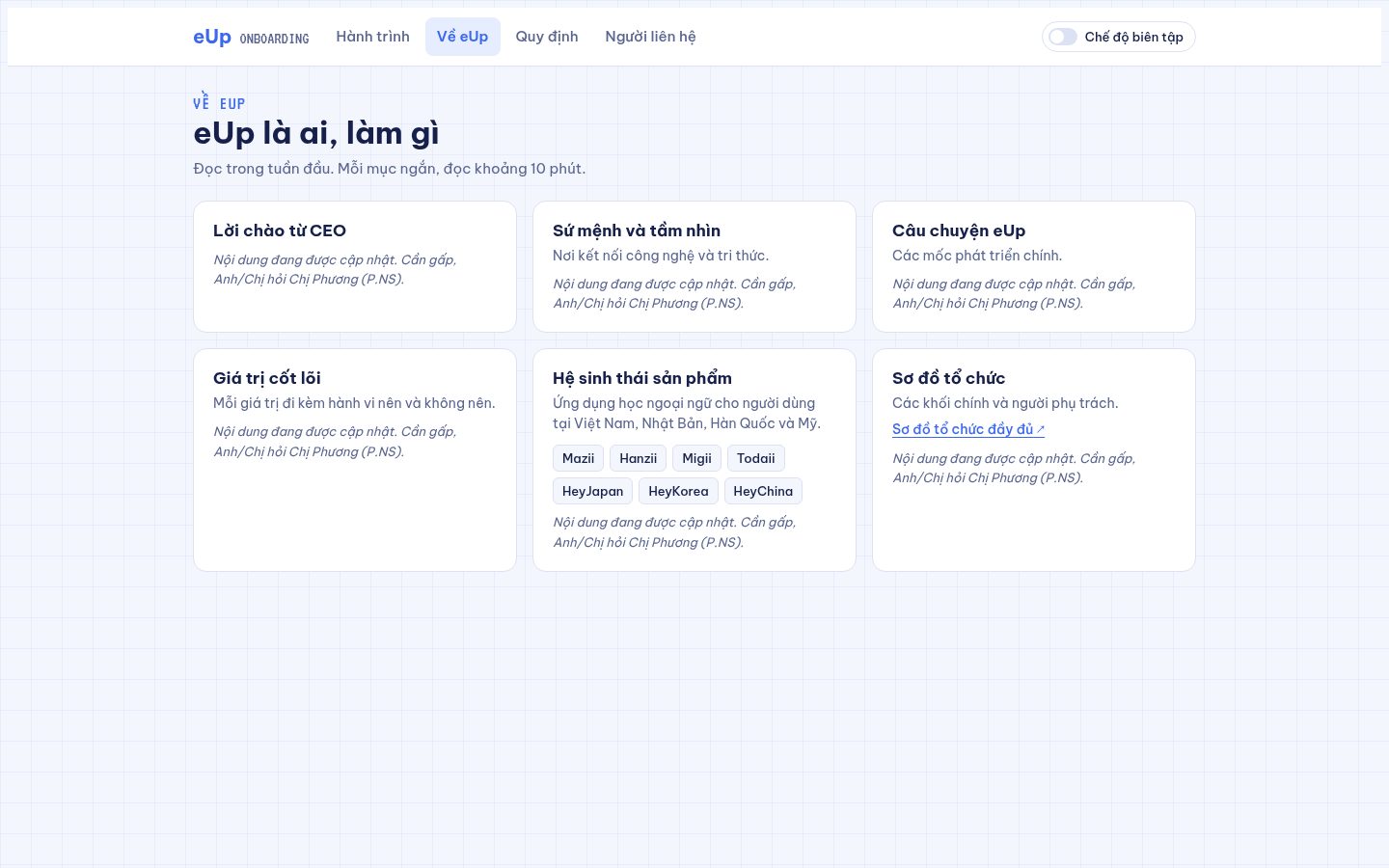
eUp Group builds an ecosystem of language-learning apps (Mazii, Migii, Todaii, HeyJapan…) and welcomes new people across many teams. Before this project, onboarding relied entirely on a 22-slide Canva deck sent to each new hire.

Reviewed against a 60-point experience scale, the deck scored only 28/60. I led the project end to end — from the audit and experience design to building the product myself.
New-hire pain points

  1. 01

    Day-one overload

    Policies, forms and links all land on day one. New hires can’t tell what to do first.

  2. 02

    Pre-day-one anxiety

    What time to arrive, who to meet, where to park — small questions that shape the first impression.

  3. 03

    Not knowing who to contact

    The directory only listed HR and Recruitment — no contact for IT, admin or payroll.

  4. 04

    No sense of belonging yet

    No mission, values, products or buddy — hard to understand the organisation you are joining.

  5. 05

    Unclear what “good” looks like

    No probation goals, review milestones or criteria — the biggest source of first-month worry.

  6. 06

    Scattered, unsafe information

    Links were scattered across places, and the wifi password was published in the deck itself.

Design question · How Might We

How might we help new hires always know exactly what to do next, at the right moment, and feel welcomed — without drowning in information?

Design Thinking process

  1. 01Empathise

    Seeing onboarding through a newcomer’s eyes

    I audited the 22-slide deck against a 60-point experience scale, then walked the journey of a new hire — from the offer letter to the end of probation. At each touchpoint I noted what the newcomer needs to know, when, and where they currently have to dig for it.

    In parallel, I ran quick interviews with 5 recent hires to hear first-hand what made them anxious, confused or forced them to ask the same questions again in their first days.

    • Content audit
    • Quick interviews with 5 new hires
    • Employee journey map
  2. 02Define

    Naming the real problem

    I clustered the findings from the audit and the interviews into 6 new-hire pain points and mapped them against the 4C onboarding model (Talya Bauer – SHRM): Compliance (rules and paperwork), Clarification (role and expectations), Culture (values and norms) and Connection (relationships).

    The old deck mostly stopped at Compliance; the other three levels were nearly empty. From there I framed the design question as a “How Might We”.

    • 4C model (Bauer)
    • Affinity mapping
    • How Might We
  3. 03Ideate

    From topics to a timeline

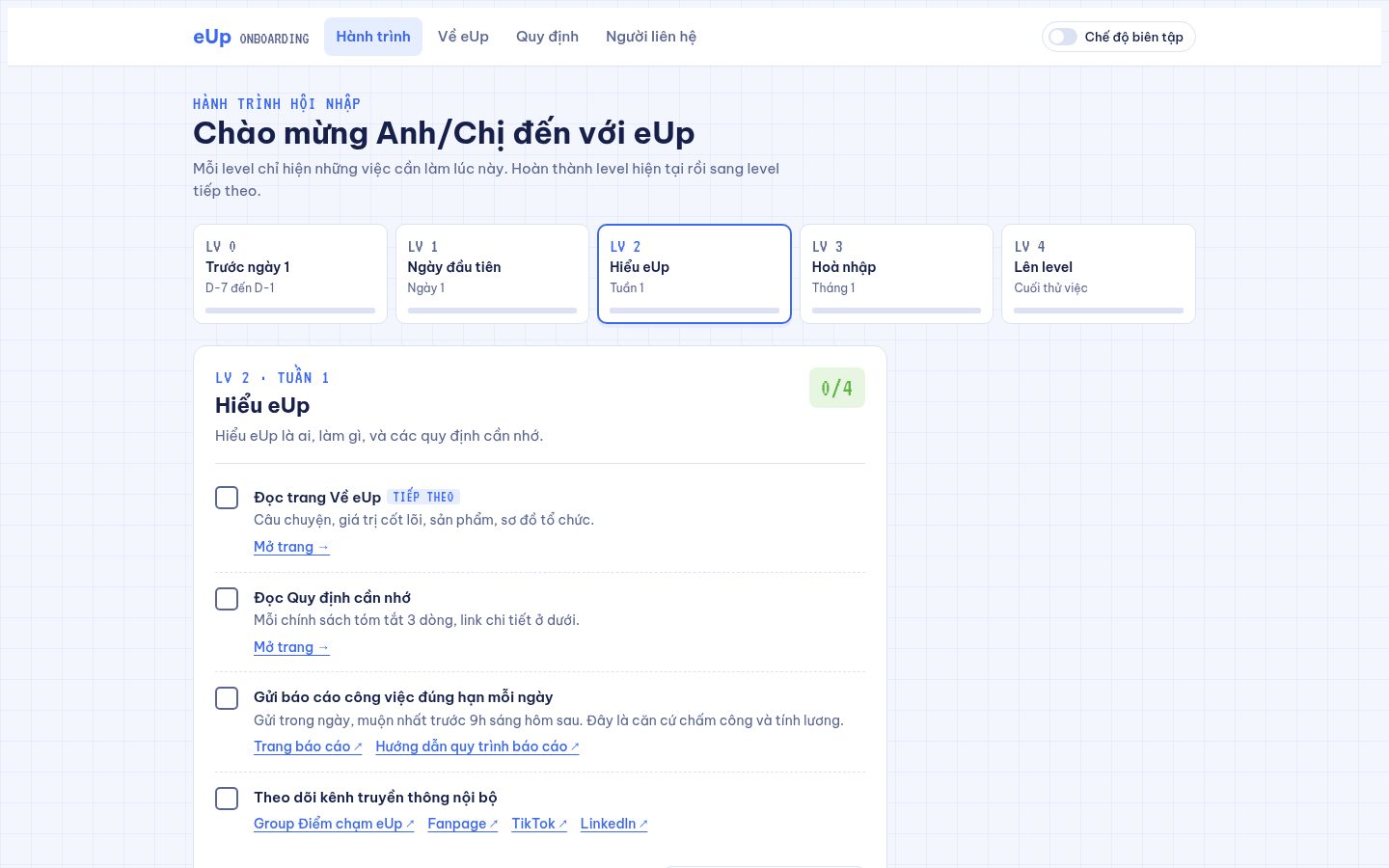
    Instead of grouping content by topic, the journey follows time, anchored on preboarding and a 30-60-90 day plan: Before day 1 → First day → Week 1 → Month 1 → End of probation. Every task maps to one level of the 4C model so all four are covered.

    To prevent overload I set 5 principles: one screen, one next task; information appears when it’s needed; summary first, link second; at most 6 tasks per level; a single source for every link.

    • Preboarding
    • 30-60-90 day plan
    • Cognitive load
  4. 04Prototype

    A working, build-free MVP

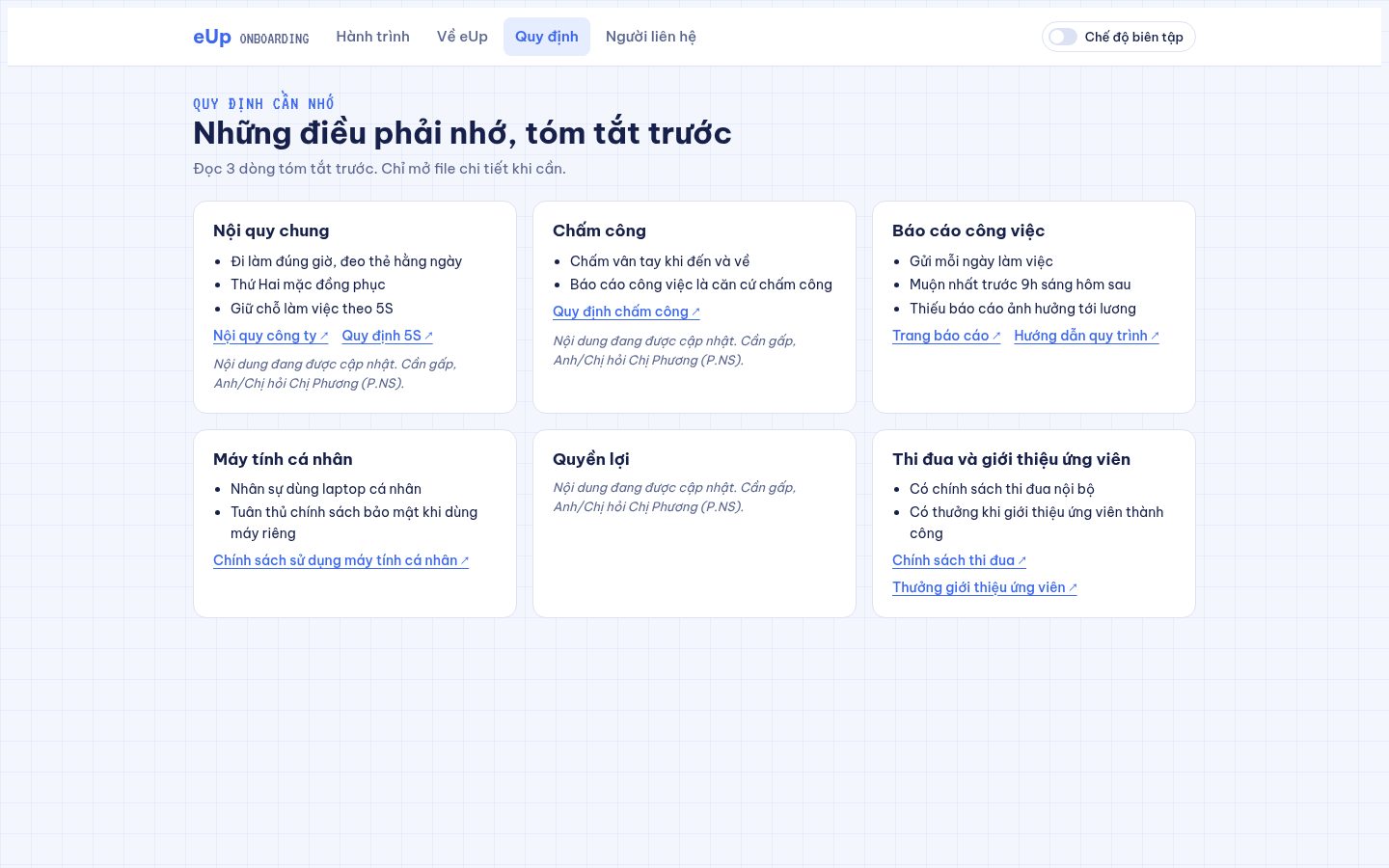
    I designed and coded a lean HTML/CSS/JS website: a 5-level journey with personal progress tracking, an About eUp page, summarised policies and a “Contacts” page organised by need. Day one includes meeting your line manager and buddy to kick-start Connection.

    An HR editing layer lists 20 missing content items, each with why it matters, what to write and an example — so teams can fill them in gradually instead of waiting for a perfect document.

    • MVP
    • Content design
    • Buddy program
  5. 05Test

    Pilot first, measure later

    The MVP is being piloted with the HR team. Onboarding success is hard to reduce to one number — it depends on managers, teams and each individual — so at this stage I deliberately haven’t set a hard KPI, to avoid optimising for something easy to count that doesn’t reflect the experience.

    Instead, qualitative feedback from HR and new hires is the main signal. Once the system has shared data, the planned measures are quick D7 and D30 surveys, level completion rates, and the Kirkpatrick model — from how new hires feel (Reaction) to how ready they are to perform after probation (Behavior).

    • HR pilot
    • Qualitative feedback
    • Planned: D7 / D30, Kirkpatrick

Results

22 → 1SLIDES BECOME ONE LINK
5NEW HIRES INTERVIEWED
4/4LEVELS OF THE 4C MODEL COVERED
20CONTENT GAPS MAPPED
Next project →AI-powered Usability Testing — Mazii

A UX research workflow built on Claude: it turns Figma designs into self-recording prototypes and evidence-based reports, so eUp product teams can validate designs with real users before development.